Recommended
Northwest
$29 TRUiC partner offer + Kentucky state fee
Form with Northwest
Kentucky LLC guide
To form a Kentucky LLC, you'll need to appoint a registered agent with a registered office in Kentucky, file the Articles of Organization (Form KLC) with the Kentucky Secretary of State's Business Filings office, and pay the $40 filing fee. You'll also need to file an Annual Report between January 1 and June 30 each year.

Verified from the Kentucky Form KLC Articles of Organization and Kentucky Annual Reports.
Recommended
$29 TRUiC partner offer + Kentucky state fee
Form with NorthwestAlternative
$249 LegalZoom Pro plan + Kentucky state fee
Form with LegalZoomTRUiC may receive compensation when you purchase through these links. Provider prices checked August 22, 2026; recommendation labels are proposed for your review.
The filing path
Use the Kentucky LLC Launchpad to check your proposed name, review the state's registered agent rules, and get a formation plan matched to your priorities before you begin Step 1.
The first step is picking a business name for your Kentucky LLC
Before you form an LLC in Kentucky, you need to decide on a business name.
Your LLC’s name should be memorable and easily searchable while also complying with the state’s naming requirements.
1. Important Naming Guidelines for Kentucky LLCs:
For more information, we recommend having a look at Kentucky’s statutory LLC naming guidelines.
2. Conduct a Business Name Search in Kentucky
To check whether your desired name has already been taken by another business entity in Kentucky, you can perform a business entity search on the Kentucky Secretary of State’s website.
If you’re not going to start your LLC right away, it might be a good idea to consider reserving your name for up to 120 days. You can do this by filing a Reservation or Renewal of Reserved Name form with the Commonwealth of Kentucky and paying the $15 processing fee.
For more information, you can have a look at our Kentucky LLC Name Search guide.
3. Conduct a Domain Name Search
Next, it’s important to determine if your business name is available as a web domain. Even if you don’t plan to make a business website right away, this is an extremely important step as it will prevent others from acquiring it.
Once you have verified your name is available, you may now select a professional service to complete the LLC formation process for you.
LLC is short for “limited liability company.” It is a simple business structure that offers more flexibility than a traditional corporation while still providing legal protection for your personal assets. Read our What is a Limited Liability Company guide for more information.
Or, watch our two-minute video: What is an LLC?
Most LLCs do not need a DBA, known as an assumed name in the state of Kentucky. The name of the LLC can serve as your company’s brand name and you can accept checks and other payments under that name as well. However, you may wish to register a DBA if you would like to conduct business under another name.
To learn more about DBAs in your state, read our How to Get a DBA in Kentucky guide.
After you find the right name for your LLC, you will need to nominate a Kentucky registered agent. This is a requirement for all LLCs in Kentucky.
What is a registered agent? A registered agent is an individual or business entity responsible for receiving important legal documents on behalf of your business. Think of your registered agent as your business’s primary point of contact with the state.
Who can be a registered agent? A registered agent must be a resident of Kentucky or a business entity that is authorized to transact business in the Commonwealth. As a new business owner, you can elect to use an LLC member (e.g., yourself, a partner, etc.), work with a business attorney, or use a registered agent service.
Get Free Registered Agent Services
Form an LLC with Northwest Registered Agent to get one year of registered agent services free of charge.
Yes. You can choose to act as your own registered agent, appoint a member of your LLC, work with a business attorney, or hire a professional registered agent service (recommended).
Read more about being your own registered agent.
Using a professional registered agent service is an affordable way to manage government filings for your LLC. For most businesses, the advantages of using a professional service significantly outweigh the annual costs.
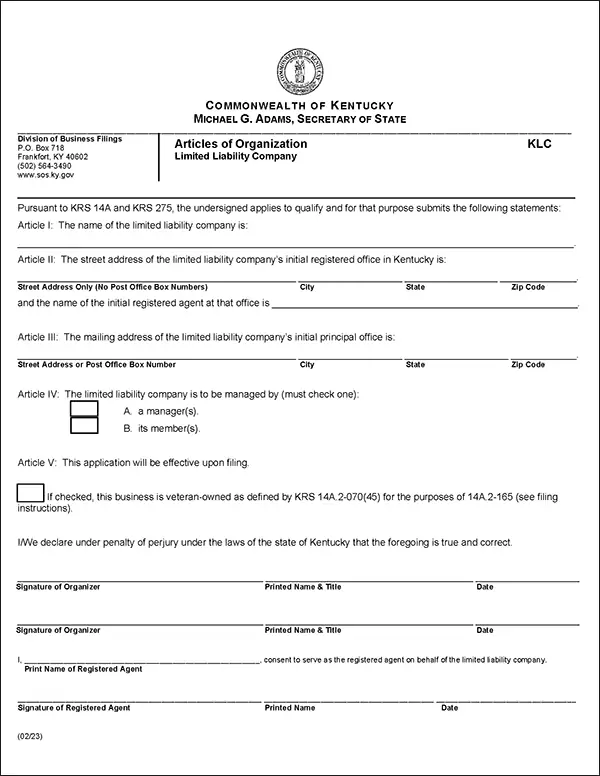
To register your LLC, you will need to file Form KLC: Articles of Organization with the Kentucky Secretary of State. You can do this online, in person, or via mail.
Before filing, make sure you have completed your Articles of Organization correctly. You will need to have filled in the following sections:
OPTION 1: File Online With the Kentucky Secretary of State
File Online– OR –
OPTION 2: File Form KLC by Mail or In Person
Download FormState Filing Cost: $40, payable to “Kentucky State Treasurer” (Nonrefundable)
Mailing Address:
Michael G. Adams
Office of the Secretary of State
P.O. Box 718
Frankfort, KY 40602
Office Address:
Room 154, Capitol Building
700 Capital Ave.
Frankfort, KY 40601
For help with completing the form, visit our Kentucky Articles of Organization guide.
Note: If you’re expanding your existing business to the state of Kentucky, you’ll need to register as a foreign limited liability company (LLC).
According to the Secretary of State’s website, all business filings (besides annual reports) are generally processed on the same day that they are received, but can take up to three business days.
An LLC is referred to as a “domestic LLC” when it conducts business in the state where it was formed. A foreign limited liability company must be formed when an existing LLC wishes to expand its business to another state.
The cost to start an LLC in Kentucky is $40.
To learn more, read our guide on the cost to form a Kentucky LLC.
An operating agreement is not required in Kentucky, but it’s a good practice to have one.
An operating agreement is a legal document outlining the ownership and operating procedures of an LLC.
A comprehensive operating agreement ensures that all LLC owners are on the same page and reduces the risk of future conflict.
You can use the free tool in our Business Center to create a custom operating agreement in minutes — or download our free templates:
No. The operating agreement is an internal document that you should keep on file for future reference. However, many other states legally require LLCs to have an operating agreement.
You can get an Employer Identification Number (EIN) from the IRS for free. It is used to identify a business entity and keep track of a business’s tax reporting. You can think of this as essentially a Social Security number (SSN) for the company.
Why do I need an EIN? An EIN is required for the following:
Where do I get an EIN? An EIN is obtained from the IRS (free of charge) by the business owner after forming the company. This can be done online or by mail.
FOR INTERNATIONAL APPLICANTS: You do not need an SSN to get an EIN. Learn more here.
Option 1: Request an EIN from the IRS
– OR –
Option 2: Apply for an EIN by Mail or Fax
Mail to:
Internal Revenue Service
Attn: EIN Operation
Cincinnati, OH 45999
Fax: (855) 641-6935
Fee: Free
An SSN is not required to get an EIN. You can simply fill out IRS Form SS-4 and leave section 7b blank. Then call the IRS at (267) 941-1099 to complete your application.
All LLCs with employees, or those with a multi-member LLC must have an EIN. This is required by the IRS.
Learn why we recommend always getting an EIN and how to get one for free in our Do I Need an EIN for an LLC guide.
When you get an EIN, you will be informed of the different tax classification options that are available. Most LLCs elect the default tax status.
However, some LLCs can reduce their federal tax obligation by choosing the S corporation (S corp) status. To learn more, read our LLC vs. S Corp guide.
| Service | Total Cost* | Filing | Registered Agent | EIN | Operating Agreement |
|---|---|---|---|---|---|
|
Northwest
TOP PICK
25% TRUiC Discount
|
$119 | $29 | Free 1st Year $125/yr after | $50 | Free |
|
Tailor Brands
35% TRUiC Discount
|
$367 | $0 | $199/yr | $99 | $29 |
|
ZenBusiness
|
$337 | $0 | $99 1st Year $199/yr after | $99 | $99 |
|
LegalZoom
|
$467 | $0 | $249/yr | $79 | $99 |
For a comprehensive comparison, read our Best LLC Services review. We reviewed and ranked the top LLC formation services to help you determine the best fit for your new business.
After you’ve formed your LLC, you’ll need to complete key steps in order to:
Using a dedicated business banking account and business credit card is essential for personal asset protection.
When your personal and business accounts are mixed, your personal assets (your home, car, and other valuables) are at risk in the event your LLC is sued. In business law, this is referred to as piercing your corporate veil.
You can protect your business with these two steps:
1. Opening a business bank account:
2. Getting a business credit card:
Even though an LLC offers limited liability, you’ll still likely need to purchase some form of business insurance to protect your LLC’s assets. The most common types are:

What This Means:
Without insurance: If someone sues your bakery for $40,000, they could take your commercial mixer and empty your business account ($25,000 total), but won’t be able to touch your house or personal savings.
With insurance: Your business liability policy could cover the $40,000 claim, meaning that both your personal and business assets would remain untouched.
That’s why many small business owners turn to providers like Ergo Next Insurance for affordable, tailored coverage. Get a free quote today.
Want to learn exactly what coverage your Kentucky business may need? Read our full Kentucky Business Insurance Guide.
While Kentucky doesn’t require a general state business license, your LLC may need specific licenses or permits based on its industry, location, and activities.
For a comprehensive overview and step-by-step instructions, refer to our Kentucky Business License Guide.
If you’d rather have a service handle this step for you, we recommend checking out LegalZoom’s Business License service.
Your Kentucky LLC will have several key tax obligations:
Kentucky imposes three types of income taxes relevant to LLC owners: individual income, corporate income, and limited liability entity tax. You can file these taxes online or by mail using the forms listed below.
If you are selling tangible or digital goods or services, you’ll need to obtain a seller’s permit through the Kentucky Department of Revenue website.
This certificate allows a business to collect sales tax on taxable sales.
Sales tax, also called “Sales and Use Tax,” is a tax levied by states, counties, and municipalities on business transactions involving the exchange of certain taxable goods or services.
Read our sales tax guide to find out more.
If you have employees in Kentucky, you’ll need to register for Unemployment Insurance Tax through the Kentucky Office of Unemployment Insurance. You’ll also need to sign up for Employer Payroll Withholding Tax through the Kentucky Department of Revenue.
Some Kentucky cities and counties have their own income tax requirements that may affect your LLC. These may include income tax, net profits tax, and gross receipts tax.
You can view the full list of cities and counties with local tax requirements on the Kentucky Secretary of State’s website.
Most Kentucky LLCs must file their state tax returns by April 15. For help understanding your full tax obligations — and making sure nothing gets missed — check out our full Kentucky LLC Tax Guide.
Need personalized help? Schedule a free consultation with 1-800Accountant to get expert guidance from CPAs who specialize in small business taxes.
All LLCs based in Kentucky are required to submit an annual report to the Secretary of State by June 30 every year along with a $15 filing fee. This report will keep the state’s records updated on key aspects of your business, such as:
You can submit this report online through the Kentucky Secretary of State website anytime between January 1 and June 30.
Note: Failing to submit your annual report by the deadline in June will result in administrative dissolution or revocation of your certificate of authority, depending on whether your LLC is a domestic or foreign entity.
To stay on top of this deadline and other important compliance tasks, we recommend hiring a professional registered agent service — they can help ensure you never miss a filing.