Recommended
Northwest
$29 TRUiC partner offer + Virginia state fee
Form with Northwest
Virginia LLC guide
To start a Virginia LLC, you'll need to appoint a registered agent with a registered office in Virginia, file the Articles of Organization (Form LLC1011-DOC) with the Virginia State Corporation Commission, and pay the $100 filing fee. You won't file an annual report, but you'll need to pay a $50 annual registration fee by the last day of your anniversary month.

Verified from 4 official sources.
Recommended
$29 TRUiC partner offer + Virginia state fee
Form with NorthwestAlternative
$249 LegalZoom Pro plan + Virginia state fee
Form with LegalZoomTRUiC may receive compensation when you purchase through these links. Provider prices checked August 22, 2026; recommendation labels are proposed for your review.
The filing path
Use the Virginia LLC Launchpad to check your proposed name, review the state's registered agent rules, and get a formation plan matched to your priorities before you begin Step 1.
The first step is picking a business name for your Virginia LLC
Before you get started, you will need to pick a suitable name for your Virginia LLC.
This will need to comply with all applicable naming requirements under Virginia law and be both succinct and memorable, as this will make it easily searchable by your potential clients.
1. Virginia LLC Naming Guidelines
For a complete list of naming rules in Virginia, you can read the State Corporation Commission guidelines.
2. Virginia Name Availability Search
To check whether your desired name has already been taken by another business entity in Virginia, you can perform a Business Entity Search on the Virginia SCC website.
If you’re not going to start your LLC right away, it might be a good idea to consider reserving your name for up to 120 days ($10 processing fee).
For more information, you can have a look at our Virginia LLC Name Search guide.
3. Finding the Right Domain
You should check online to see if your business name is available as a web domain. Even if you don’t plan to make a business website right away, this is an extremely important step as it will prevent others from acquiring it, potentially saving you both time and money in the long term.
Once you have verified your name is available, you may now select a professional service to complete the LLC formation process for you.
LLC is short for “limited liability company.” It is a simple business structure that offers more flexibility than a traditional corporation while providing many of the same benefits. Read our What is a Limited Liability Company guide for more information.
Or, watch our two-minute video: What is an LLC?
You must follow the Virginia limited liability company naming guidelines when choosing a name for your LLC:
If you are having trouble coming up with a name for your LLC, use our LLC Name Generator. That will not only find a unique name for your business but an available URL to match.
Most LLCs do not need a DBA, known in Virginia as a fictitious or assumed name. The name of the LLC can serve as your company’s brand name and you can accept checks and other payments under that name as well. However, you may wish to register a DBA if you would like to conduct business under another name.
To learn more about DBAs in your state, read our How to File a DBA guide.
After you find the right name for your LLC, you will need to nominate a Virginia registered agent. This is a necessary step in your Articles of Organization (i.e., the document used to file and register your LLC with the State Corporation Commission).
What is a registered agent?
A registered agent is an individual or business entity responsible for receiving important tax forms, legal documents, notice of lawsuits, and official government correspondence on behalf of your business. You can think of your registered agent as your business’s primary point of contact with the state.
Who can be a registered agent?
A registered agent must be a resident of Virginia or a corporation, such as a registered agent service, authorized to transact business in the state of Virginia. If you choose to act as your own registered agent, you will need to appoint an individual within the company as Virginia law prevents business entities from acting as their own registered agents.
For a more detailed explanation of the requirements for registered agents in this state, you can refer to the rules found in Chapter 12, Article 3 of the Code of Virginia.
Get Free Registered Agent Services
Form an LLC with Northwest Registered Agent to get one year of registered agent services free of charge.
Yes. You can choose to act as your own registered agent, appoint a member of your LLC, work with a business attorney, or hire a professional registered agent service (recommended).
Read more about being your own registered agent.
Using a professional registered agent service is an affordable way to manage government filings for your LLC. For most businesses, the advantages of using a professional service significantly outweigh the annual costs.
To register your Virginia LLC, you’ll need to file Form LLC1011: Articles of Organization with the State Corporation Commission. You can do this online or by mail.
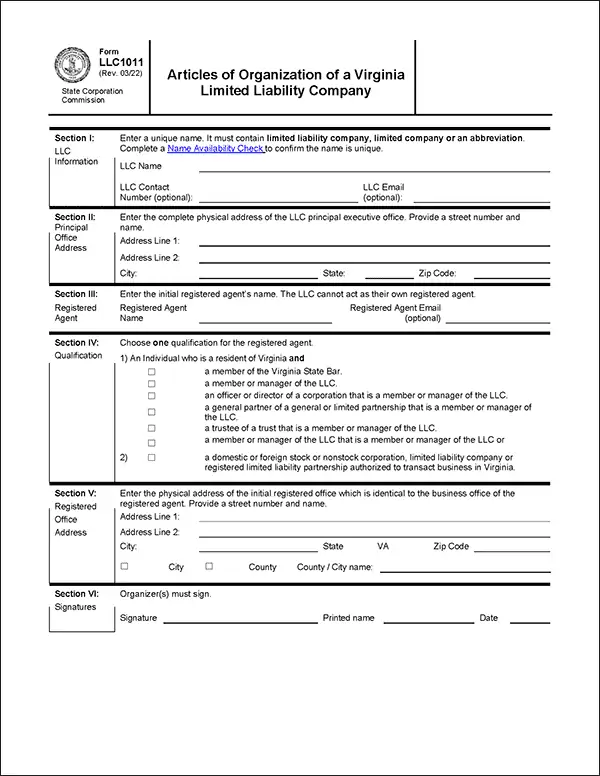
Before filing, make sure you have completed your Articles of Organization correctly. You will need to have filled in the following sections:
OPTION 1: File Online With the Virginia State Corporation Commission
File Online– OR –
OPTION 2: File Form LLC1011 by Mail
Download FormState Filing Cost: $100, payable to the State Corporation Commission. (Nonrefundable)
Mailing Address:
State Corporation Commission
Clerk’s Office
P.O. Box 1197
Richmond, VA 23218-1197
For help with completing the form, visit our Virginia Articles of Organization guide.
Note: If you’re expanding your existing business to the state of Virginia, you’ll need to register as a foreign limited liability company (LLC).
Filing the Articles of Organization takes between 3 and 12 days to process, though the following expedited options are available if you file online:
An LLC is referred to as a “domestic LLC” when it conducts business in the state where it was formed. A foreign limited liability company must be formed when an existing LLC wishes to expand its business to another state.
Read our What Is a Foreign LLC article to learn more.
The cost to file your Articles of Organization and start your LLC in Virginia is $100. It’s worth noting that your total cost may vary depending on whether you opt for expedited filing or hire a business attorney to guide you through this process.
To learn more, read our guide on the cost to form a Virginia LLC.
In Virginia, LLCs are not required to have a written operating agreement, but it’s a good practice to have one.
What is an operating agreement? An operating agreement is a legal document outlining the ownership and operating procedures of an LLC.
Why are operating agreements important? A comprehensive operating agreement ensures that all LLC members are on the same page and reduces the risk of future conflict.
You can use the free tool in our Business Center to create a custom operating agreement in minutes — or download our free templates:
No. The operating agreement is an internal document that you should keep on file for future reference. However, many other states legally require LLCs to have an operating agreement.
You can get an Employer Identification Number (EIN) from the IRS for free. It is used to identify a business entity and keep track of a business’s tax reporting. It is essentially a Social Security number (SSN) for the company.
Why do I need an EIN? An EIN is required for the following:
Where do I get an EIN? An EIN is obtained from the IRS (free of charge) by the business owner after forming the company. This can be done online or by mail.
FOR INTERNATIONAL APPLICANTS: You do not need an SSN to get an EIN. Learn more here.
Option 1: Request an EIN from the IRS
– OR –
Option 2: Apply for an EIN by Mail or Fax
Mail to:
Internal Revenue Service
Attn: EIN Operation
Cincinnati, OH 45999
Fax: (855) 641-6935
Fee: Free
A Social Security number is not required to get an EIN. You can simply fill out IRS Form SS-4 and leave section 7b blank. Then call the IRS at (267) 941-1099 to complete your application. Learn more about applying as an international applicant.
All LLCs with employees, or any LLC with more than one member, must have an EIN. This is required by the IRS.
Learn why we recommend always getting an EIN and how to get one for free in our Do I Need an EIN for an LLC guide.
When you get an EIN, you will be informed of the different tax classification options that are available. Most LLCs elect the default tax status.
However, some LLCs can reduce their federal tax obligation by choosing the S corporation (S corp) status. To learn more, read our LLC vs. S Corp guide.
| Service | Total Cost* | Filing | Registered Agent | EIN | Operating Agreement |
|---|---|---|---|---|---|
|
Northwest
TOP PICK
25% TRUiC Discount
|
$179 | $29 | Free 1st Year $125/yr after | $50 | Free |
|
Tailor Brands
35% TRUiC Discount
|
$427 | $0 | $199/yr | $99 | $29 |
|
ZenBusiness
|
$397 | $0 | $99 1st Year $199/yr after | $99 | $99 |
|
LegalZoom
|
$527 | $0 | $249/yr | $79 | $99 |
For a comprehensive comparison, read our Best LLC Service guide. We reviewed and ranked the top LLC formation services to help you determine the best fit for your new business.
After you’ve formed your LLC, you’ll need to complete several key steps in order to:
Getting a dedicated business bank account is an essential part of operating legitimately because it keeps your personal and business assets separate therefore helping to shield your personal limited liability.
Skipping this step can often lead to:
Recommended: Read our Best Business Bank Accounts for LLCs in 2026 review.
You also may choose to acquire a corporate credit card if you’re interested in building your LLC’s credit and potentially raising capital down the line.
Virginia doesn’t require LLCs to hold a “general” business license in order to operate.
However, business licensing is regulated at a local, state, and federal level so your licensing needs will ultimately depend on your exact location and industry.
A few questions to ask yourself when deciding whether or not you need a license include:
For more information, see our Virginia Business License guide. If you’d rather have a service handle this step for you, we recommend checking out LegalZoom’s Business License service.
Virginia LLCs aren’t all taxed in the same way because LLCs are taxed as pass-through entities by default. This means they’re largely taxed similarly to sole proprietors — the business gets paid, the profits pass to you as the owner, and you get taxed. There’s no “corporate” tax involved.
You’ll need to submit personal income tax returns using either Form 1040 (for single member LLCs) or Form 1065 (for multi-member LLCs). If you have employees, you’ll also be subject to federal income tax withholding.
Virginia has a state individual income tax that ranges from 2% to 5.75%, which members of pass-through LLCs must pay on their share of the profits. LLCs taxed as corporations are instead subject to a flat 6% corporate income tax.
You also may need to collect and remit state sales and use tax if you sell taxable goods or services and register for employer withholding if your LLC will have employees.
Your LLC may need to pay local sales taxes, property taxes, or other location-based business taxes at the county or municipal level.
For more information on the Virginia-specific LLC tax obligations that may apply to you, check out our in-depth Virginia LLC Taxes guide. Alternatively, you can schedule a free online consultation with 1800-Accountant for all your tax-related questions.
Even though an LLC offers limited liability, you’ll still likely need to purchase some form of business insurance to protect your LLC’s assets.
This is because an LLC’s default limited liability protects your personal assets, not the business’s. Some of the most common types of business insurance include:

What This Means:
Without insurance: If a customer slips on a wet floor during an event catered by your LLC and files a $69,000 lawsuit for medical bills and lost income, your commercial kitchen equipment, event supplies, and $15,000 in outstanding client payments could be at risk — although your personal assets would still be protected.
With insurance: Your general liability policy could cover the full $69,000 claim, meaning that both your personal assets and business property would remain protected.
That’s why many small business owners turn to providers like Ergo Next Insurance for affordable, tailored coverage. Get a free quote today.
Want to learn exactly what coverage your business may need? Read our full Virginia Business Insurance guide.
Improperly signing a document as yourself and not as a representative of the business can leave you open to personal liability.
When signing legal documents on behalf of your company, you we recommend following this formula to avoid any problems:
It’s important to be consistent and sign all official documents using this format. This’ll help protect your personal assets by clearly showing that the agreement is with the LLC, not you as an individual.
Instead of a full annual report, Virginia requires payment of a $50 annual registration fee to the State Corporation Commission. This can be paid online and is due on the last day of the month in which your LLC was registered to transact business in Virginia.
Note: If your LLC misses the filing deadline for annual registration, it will be charged a $25 late fee. If you have failed to pay your annual registration within three months of this deadline, your LLC will be administratively dissolved.
To stay on top of this deadline and other important compliance tasks, we recommend hiring a professional registered agent service — they can help ensure you never miss a filing.
Check out our business center for regular updates, vetted reviews, free downloadable templates, and video guides that aim to help you start and grow your business.
More on Virginia LLCs: